YUHA vs WHOOP
WHOOP is a wearable band that scores your recovery and strain. YUHA is a coach that works from the tracker you already own and turns it into today's session.
At a glance
| YUHA | WHOOP | |
|---|---|---|
| What it is | A coach that reads the tracker you already own | A wearable band sold as a membership |
| Hardware | None to buy. Works with Garmin, Strava, Apple Health, Health Connect or an Ultrahuman Ring | A WHOOP band, included in each of its three memberships: One, Peak and Life |
| The morning number | A readiness score from 0 to 100, read as ready, caution or rest | A Recovery percentage, shown as green, yellow or red |
| What goes into it | Sleep against your own need, recovery, training load, daily movement and your check-in | Heart rate variability, resting heart rate, sleep performance and respiratory rate, measured by the band |
| What it tells you to do | Today's session: the workout to run, ease or skip, with the reason | A recommended amount of strain for the day |
| Training plans | For any race distance, adapting as recovery and load change | Sleep, strain and recovery insights with personalized coaching |
What WHOOP does
WHOOP is a wearable band sold as a yearly membership in three tiers, One, Peak and Life, each with the band included. Every morning it calculates a Recovery percentage and colors it: green means well recovered, yellow means the body can take a moderate day, and red means rest is likely what you need. WHOOP says Recovery draws on heart rate variability, resting heart rate, sleep performance and respiratory rate, all measured by the band while you sleep.
From that number WHOOP recommends how much strain to take on that day, and it tracks the strain you build up. WHOOP describes its insights as 24/7 and its Recovery as a measure of how prepared your body is to perform, whatever it is that you do.
What YUHA does differently
YUHA needs no new hardware. It builds a readiness score from the Garmin, Apple Health, Health Connect, Strava or Ultrahuman data you already have, then goes one step further and decides the session: what to run today, and how a training plan should shift around it. It is a coach for runners, so the output is a workout and an explanation, not only a score.
What a morning in YUHA looks like
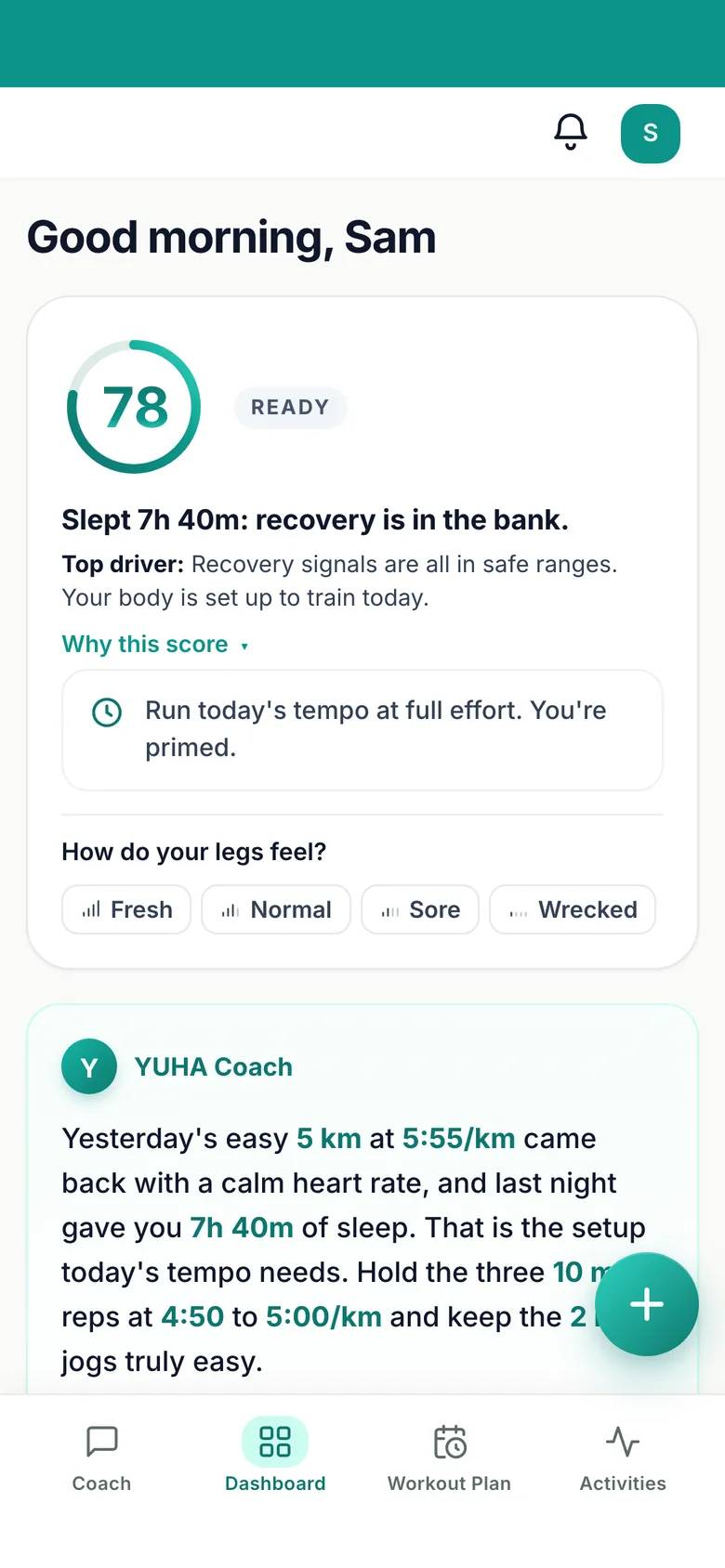
This is the screen a runner opens in the morning. From top to bottom:
- The score and the call. A number from 0 to 100 and one word: ready, caution or rest.
- The top driver. The one thing that moved the score most today, in a sentence.
- Today's session. What to do with that: run the planned workout, ease it, or rest.
- The check-in. One tap for how your legs feel. Sore or wrecked lowers the call. Fresh never raises it.
- The coach's read. A short note that ties yesterday's run and last night's sleep to today.
The picture shows sample data.
A Recovery score and a readiness score are not the same number
Both answer the question "how hard should today be?", from different evidence.
- WHOOP Recovery is built from what the band measures overnight: your heart, your breathing and your sleep.
- YUHA readiness is built from five inputs: sleep against your own need, the recovery signal your tracker offers, your training load against the weeks you have handled before, your daily movement, and how you say your legs feel in one tap. Sore or wrecked lowers the call, and fresh never raises it.
- What happens next differs too. WHOOP recommends an amount of strain for the day. YUHA names the workout.
Using both
YUHA has no direct WHOOP connection. If WHOOP shares your sleep and workouts with Apple Health on iPhone or Health Connect on Android, YUHA reads them there, as it does for any app. If no HRV comes through that way, YUHA reads your recovery from your resting heart rate instead.
Who each suits
- WHOOP suits someone who wants a dedicated, always-on recovery band and tracks more than running.
- YUHA suits a runner who already has a watch or ring and wants the data turned into a clear call for today's run, with a plan built around a race.
Common questions
Can YUHA read my WHOOP data?
Not directly. YUHA has no WHOOP connection. If WHOOP shares your sleep and workouts with Apple Health on iPhone or Health Connect on Android, YUHA reads them there, as it does for any app. If no HRV comes through that way, YUHA reads your recovery from your resting heart rate instead.
Is YUHA's readiness score the same as a WHOOP Recovery score?
They answer a similar question with different inputs. YUHA's score uses sleep, recovery, training load, movement and your own check-in, and it is tied to a specific running session.
Do I need to buy a band or a watch to use YUHA?
No. YUHA reads Garmin, Strava, Apple Health, Health Connect and the Ultrahuman Ring, and works with whichever of them you already have.
Does YUHA build training plans?
Yes. YUHA builds training plans for any race distance, adapts them as your recovery and training load change, and sends planned runs to a Garmin watch, or to an Apple Watch through the YUHA iPhone app.
Does YUHA track training load the way WHOOP tracks strain?
YUHA compares your last week of training with your own last 24 weeks, so a week in line with what you have handled before does not count against you. That training load is one of the five inputs to the readiness score.