YUHA vs Athletica
Athletica builds adaptive training plans across several endurance sports. YUHA is built for runners and turns the tracker you already own into a daily readiness call.
At a glance
| YUHA | Athletica | |
|---|---|---|
| What it is | A coach for runners that makes a daily readiness call | Adaptive training plans for endurance sports |
| Sports | Running plans. Every sport counts as training | Triathlon, duathlon, running, cycling, rowing and HYROX |
| Running distances | Any race distance | 5K to ultramarathon |
| How it adapts | Each morning, from sleep, recovery, training load, movement and your check-in | To your fitness, fatigue and schedule, from your performance and recovery |
| Works with | Garmin, Strava, Apple Health, Health Connect, Ultrahuman Ring | Garmin, Strava, COROS, Wahoo, Concept2 and Watchletic |
| Where it runs | iPhone, Android and the web | iPhone and Android apps |
| Trying it | Free to start | Two weeks free, no credit card |
What Athletica does
Athletica makes adaptive training plans that adjust to your fitness, fatigue and schedule. It covers triathlon, duathlon, running, cycling, rowing and HYROX. For runners it has 5K and 10K plans, half and full marathon plans, and ultramarathon plans. It builds the plan from your performance data, recovery trends and training history, then keeps adapting it: it analyzes your performance and recovery to adjust each workout, and it recalculates the week after a missed day.
Its running plans mix mostly easy running with small doses of hard work and simple strength exercises. It has a conversational coach you can ask about your training, which explains and suggests but does not change the plan by itself, a Workout Wizard, and lessons it calls Athletica U. It syncs with Garmin, Strava, COROS, Wahoo, Concept2 and Watchletic. Athletica is a paid subscription with a two-week free trial that needs no credit card.
What YUHA does differently
YUHA needs no new hardware. It builds a readiness score from the Garmin, Apple Health, Health Connect, Strava or Ultrahuman data you already have: last night's sleep against your own need, your recovery, your training load against your own recent weeks, your daily movement and a one-tap check-in. The score becomes one of three calls, ready, caution or rest, and that call decides today's session. On a ready day the planned workout stands. On a caution or rest day YUHA eases it and says why.
It also builds training plans for any race distance, adapts them as your recovery and training load change, and sends planned runs to a Garmin watch, or to an Apple Watch through the YUHA iPhone app.
YUHA counts every sport as training, so a ride, a swim or a yoga session is part of your load. Its training plans are for running races.
What a morning in YUHA looks like
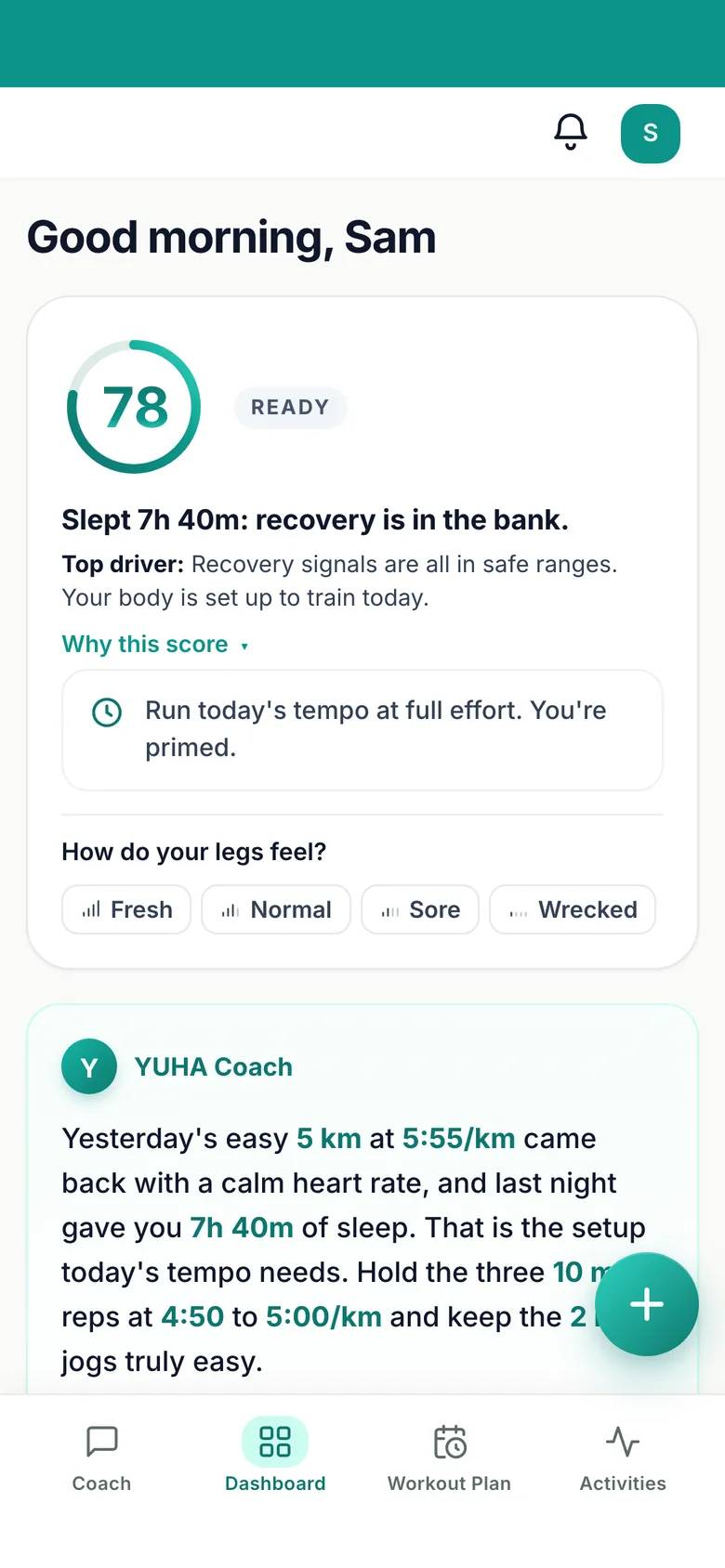
This is the screen a runner opens in the morning. From top to bottom:
- The score and the call. A number from 0 to 100 and one word: ready, caution or rest.
- The top driver. The one thing that moved the score most today, in a sentence.
- Today's session. What to do with that: run the planned workout, ease it, or rest.
- The check-in. One tap for how your legs feel. Sore or wrecked lowers the call. Fresh never raises it.
- The coach's read. A short note that ties yesterday's run and last night's sleep to today.
The picture shows sample data.
Several sports, or one sport read closely
Athletica's strength is range. A triathlete gets one plan that balances swim, bike and run, and a rower or a HYROX athlete gets a plan for their sport. YUHA's focus is narrower: the runner, and the question of what to run today given how recovered they are.
Both read recovery as well as training. YUHA puts it first: each morning it turns last night's sleep, the recovery signal from your watch or ring, your training week against your own recent weeks and how your legs feel into one score and one call, before the plan gets a say.
Using both
These tools are not mutually exclusive. YUHA reads Garmin, Apple Health, Health Connect and Strava, so the runs you do under a plan from Athletica still reach YUHA once they are on your watch or in one of those apps. YUHA then reads your sleep, recovery and training load around them and tells you each morning whether today is a day to push.
Who each suits
- Athletica suits an endurance athlete who trains for more than one sport and wants a structured plan for each.
- YUHA suits a runner who wants a clear call for today's run from sleep, recovery and load, without building around a multi-sport plan.
Common questions
Is YUHA for triathletes?
YUHA is built for runners. It counts rides, swims, yoga and hikes as training, but its training plans are for running races. Athletica has plans for triathlon and duathlon.
Do I need a specific watch for either one?
No. Athletica syncs with Garmin, Strava, COROS, Wahoo and Concept2. YUHA reads Garmin, Strava, Apple Health, Health Connect and the Ultrahuman Ring.
Which running distances does Athletica cover?
Athletica has running plans from 5K to ultramarathon. YUHA builds training plans for any race distance.
Does Athletica have a free trial?
Yes. Its site offers a two-week free trial with no credit card required. YUHA is free to start.
What is YUHA's readiness score?
A number from 0 to 100, rebuilt every morning from your sleep, recovery, training load, daily movement and a one-tap check-in. A score of 75 or higher reads as ready, 55 to 74 as caution, and below 55 as rest.